



Property registration in Gurugram is the next level thing to complete the property purchase journey. And ownership being the top priority. However, it is crucial to know the required documents for registering property here. But, the absence of document(s) can cause a delay in processing.
So, here in this blog, we list all the necessary documentation you need to keep handy for further processing.
Table of Contents
What does Registration of Property Means?
The registry of property is a legal document that binds the seller and buyer legally. Hence, he registration of an immovable asset clearly states that the buyer is now the official owner. That means the buyer is responsible for the respective property from now onwards.
Property registration in Gurugram is compulsory. Any property sale/purchase without a legal agreement comes under unlawful activity. Hence, such type of immovable asset remains unlisted in the Government records. Hence, the owner will remain refrained from all the basic amenities.
Steps for Property Registration in Gurugram
In Gurugram, the office of Sub-Registrar carries out the registration process. Thus, to make the sale deed effective, complete documentation within four months from the date of process commencement is necessary. Post document submission, the Sub-Registrar verifies the same and releases the certificate of property registry. However, the Sub-Registrar can cancel the release if any document is found to be suspicious.
At the time of property registration in Gurugram, the concerned authority also considers the property value while assessing the stamp duty and registration cost.
What are the Ways for Property Registration in Gurugram?
Prior to the pandemic’s hit, the offline process for registering properties was in action. However, during the pandemic, the State Government came to know about the scam at the tehsil office. Here several officials conspired fake registration of over 1100+ properties with the help of property dealers. Hence, the use of the offline registration process stopped.
However, after a 40-day ban, the State Government gave green signal to online services for registering properties in the city. Ever since, the online process is in action.
Online Process for Property Registration in Gurugram
Step 1: Visit the official website of Haryana State Government
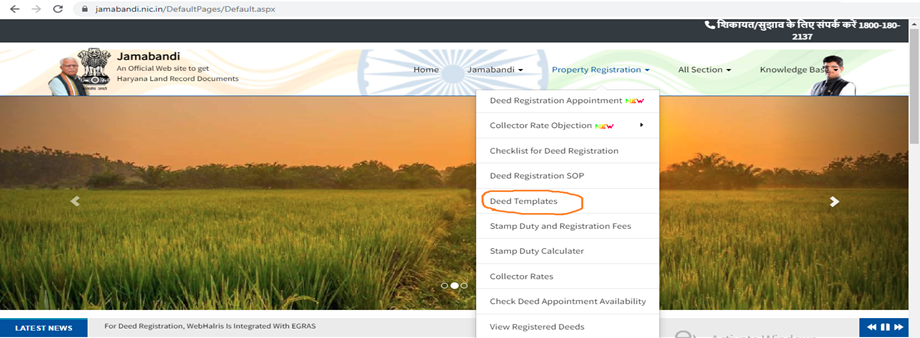
For property registration in Gurugram, visit https://jamabandi.nic.in/defaultpages/default.aspx. It is the official website of the Haryana State Government to register properties. Click on the “Deed Template” under the Property Registration tab on the home page.
Step 2: E-Stamp Generation
To continue the registration process, you need to buy E-Stamp. You can purchase it from the bank or online. To buy E-Stamp online, visit https://egrashry.nic.in/ and CLICK on the “E-STAMP” tab. Duly fill in the appropriate information for generating stamps. Be accurate in filling in the answers as security check and password.
Step 3: Book Appointment Time
Book an appointment prior submission of their sales deed copy. To complete property registration in Gurugram, find the “Property Registration” on the home page. Select the “Check Deed Appointment Availability” listed on the main website.
Step 4: Visit the office of Sub-Registrar
Be there at the office of the Sub-Registrar office at the given time to complete the verification process. It includes biometric and photo verification. Thus, you have to submit one copy of each.
Step 5: Payment of Stamp Duty and Registration Fee
Also, you have to pay these charges at the office of the Sub-Registrar. After which, you will receive an acknowledgment. Hence, keep it safe, as it will come handy for a property transaction in the future.
What is the Stamp Duty in Gurugram?
The taxes levied by the Government on legal document processing is called Stamp Duty. This amount is based on the transaction value or the circle rate. Depending on whichever is higher. However, the stamp duty charge is 7% for the male owners. While, it stands at 5% for female owners. Also, the stamp duty charge is 6%, if the property is owned jointly.

